
Review · BETHLEHEM & JERICHO DAY TRIPS
Travel to Bethlehem, Jericho and Qaser Al Yahud – Guided Tour From Jerusalem
Three holy places, one long day. This shared tour links Bethlehem, Jericho, and Qaser Al Yahud in a way that is hard to arrange alone. I like the lively Bethlehem guide work, especially the reports of Elias’s humor, and I like the air-conditioned transport between far-flung sites. The main drawback is pace: the day can last 8 to 11 hours, and the group may include as many as 55 people.
The strongest part is Bethlehem, where a local guide explains the Church of the Nativity, St. Catherine’s Church, the Milk Grotto, and the Shepherd’s Field. After that, Jericho and the Jordan River are largely self-guided, so you get less explanation and must budget extra cash for entrance fees.
In This Review
- Key points to know before booking
- Why this full-day route works
- Bethlehem begins with the Church of the Nativity
- St. Catherine’s Church and the Cave of Jerome
- The Milk Grotto and a story of refuge
- Shepherd’s Field in Beit Sahour
- Why the Bethlehem guide matters
- Jericho shifts from churches to ruins
- Hisham’s Palace and Tel es-Sultan
- The Mount of Temptation is deliberately left out
- Qaser Al Yahud and the Jordan River
- What the $80 price really covers
- Who should book this tour
- Final recommendation: book it for breadth, not leisure
- FAQ
- How long does the tour last?
- What is included in the price?
- Is lunch included?
- Are Jericho and the Jordan River guided?
- How much are the Jericho entrance fees?
- Does the tour visit the Mount of Temptation?
Key points to know before booking
- Bethlehem receives the best guiding: This is the only part specifically covered by a guided tour, with Elias, Johnny, and other local guides praised for clear explanations and good humor.
- The Nativity grotto may require patience: On ordinary days, the wait can run from 30 to 90 minutes. On Sundays and holidays, access is not guaranteed.
- Jericho adds archaeology, not just Bible stories: Tel es-Sultan and Hisham’s Palace bring ancient and early Islamic sites into the day, but admission costs extra.
- Qaser Al Yahud is a short Jordan River visit: You spend about 15 minutes at the baptismal area within a roughly 30-minute stop.
- The Mount of Temptation is not included: You will not take the cable car or visit the mountain itself.
- The $80 price covers transport and Bethlehem guiding: Lunch, Jericho admissions, and the Hisham’s Palace fee are separate.
Why this full-day route works
This is a useful route for you if you want to cover several major West Bank sights from Jerusalem without piecing together buses, taxis, border crossings, and local arrangements. The distance between Bethlehem, Jericho, and Qaser Al Yahud makes an organized vehicle practical, especially in an air-conditioned coach.
The route also gives you three different kinds of experience. Bethlehem is centered on Christian worship and living religious tradition. Jericho shifts toward archaeology and biblical stories. Qaser Al Yahud brings you to the Jordan River, a place tied to Christian baptism traditions.
That variety is the appeal. You are not spending the entire day inside churches, and you are not spending it all at ruins either.
The trade-off is that the outing is shared and potentially large. A maximum of 55 people means boarding, regrouping, and moving through crowded sacred places can take time. Some departures may be smaller, with one account describing a group of about 20 in Bethlehem, but you should plan for a full coach rather than a small private party.
More Bethlehem and Jericho crossings:
- Jerusalem and Bethlehem Day Tour from Jerusalem
★ 4.5 · 258 reviews - Travel to Bethlehem Half Day Guided Tour from Jerusalem & TelAviv
★ 5.0 · 239 reviews - Ashdod Shore Excursion: Jerusalem and Bethlehem – for cruise ship guests only
★ 4.5 · 149 reviews
Bethlehem begins with the Church of the Nativity
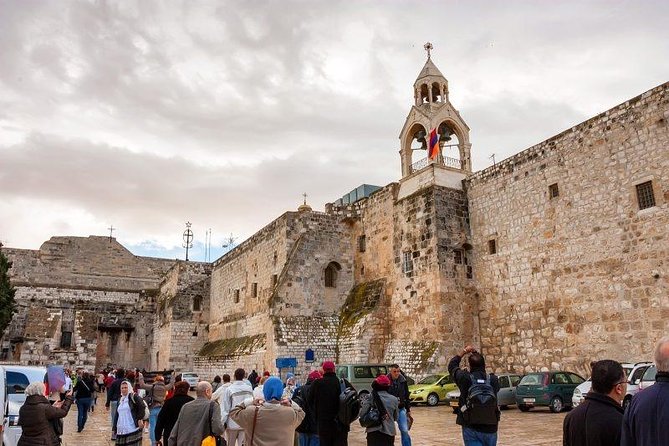
The Church of the Nativity is the emotional center of the day. The first church here was built under the Roman Emperor Constantine in the fourth century, over the grotto traditionally identified as the birthplace of Jesus. It is also one of the oldest working churches still in use.
You receive a guided visit in Bethlehem, which matters here. This is not simply a quick photo stop. The churches, chapels, underground spaces, and traditions can be confusing without someone to put them in order. Guides such as Elias have been praised for combining facts with humor, a useful skill when a long day begins with a potentially crowded holy site.
The key practical point is the grotto queue. On regular days, you might wait 30 to 90 minutes to see the exact place associated with the birth of Jesus. On Sundays and holidays, the grotto cannot be guaranteed. If seeing the grotto is your main reason for booking, you should accept that uncertainty before paying.
The listed visit gives about 40 minutes, but the wait can affect how much time remains for other parts of the church. Keep your expectations flexible. The value is not only in reaching one small shrine. It is also in seeing a functioning place of worship shared by different Christian traditions.
St. Catherine’s Church and the Cave of Jerome
Next door or nearby in the Bethlehem religious complex, St. Catherine’s Church brings a Franciscan setting into the morning. The church is linked to the story of Christ appearing to St. Catherine of Alexandria and foretelling her martyrdom in the early fourth century.
You have around 30 minutes here. That is enough for an orientation and a look at the church, but not a slow study of every detail. The Franciscan presence also helps explain why Bethlehem is more than a single famous basilica. It is a working religious center with several connected traditions.
Beneath St. Catherine’s is the Cave of Jerome. St. Jerome was a Dalmatian priest who lived from 345 to 420 AD and translated much of the Old Testament from Hebrew and Greek into the Latin Vulgate. The cave gives the visit a scholarly side, linking the Bethlehem churches to the long work of preserving and translating Christian scripture.
Access to the cave is through St. Catherine’s, so ask the guide how the visit is being handled that day. The schedule includes the cave as part of the Bethlehem portion, but the supplied timing does not give it a separate stop length.
The Milk Grotto and a story of refuge
The Milk Grotto is a smaller church with a very different character from the Church of the Nativity. Christian tradition holds that the Holy Family took refuge here during the Massacre of the Innocents before fleeing to Egypt.
The name comes from a local story: a drop of Mary’s milk fell onto the cave floor and turned the stone white. You may appreciate this stop precisely because it is more intimate and focused than the large nativity complex. The scheduled visit lasts about 25 minutes.
As with several sites on this route, the value depends on your interest in religious tradition. If you prefer archaeology with firm physical evidence, some stories may feel devotional rather than historical. The tour is best understood as a visit to living Christian places, where faith, memory, and architecture overlap.
A few more Jerusalem trips worth weighing up
- From Jerusalem: Masada & Dead Sea Full Day Tour with Pick Up
★ 4.5 · 815 reviews - Masada and the Dead Sea Day Trip from Jerusalem
★ 4.5 · 757 reviews - From Jerusalem: Nazareth and Sea of Galilee Tour
★ 4.5 · 588 reviews - Nazareth and the Sea of Galilee Day Trip from Jerusalem
★ 4.5 · 446 reviews
Shepherd’s Field in Beit Sahour
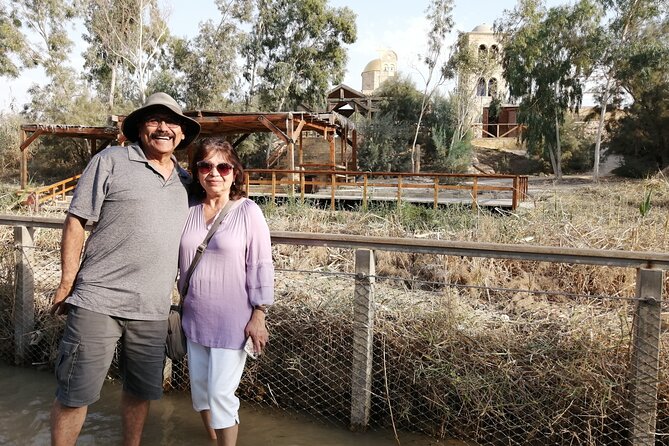
The Shepherd’s Field Chapel lies in Beit Sahour, southeast of Bethlehem. It marks the place traditionally associated with the angels announcing the birth of Christ to the shepherds.
The stop lasts about 35 minutes, making it one of the more substantial Bethlehem visits. That gives your guide time to explain the story and the chapel’s setting rather than rushing you through a doorway.
I like the way this part of the day widens the Bethlehem story beyond the birthplace itself. You move from the grotto of the nativity to the fields connected with the announcement. It gives the morning a clearer sequence, even though the schedule is busy.
The Bethlehem portion also includes the old city and may pass by places such as the Aida refugee camp, the Bab idDeir Art Gallery, and the Carmelite tradition connected with Mount Carmel, Elijah, and the Virgin Mary. These entries suggest a wider look at Bethlehem’s religious and cultural setting, but the supplied schedule does not assign each one a separate duration. Do not assume you will receive a full visit at every named location.
Why the Bethlehem guide matters
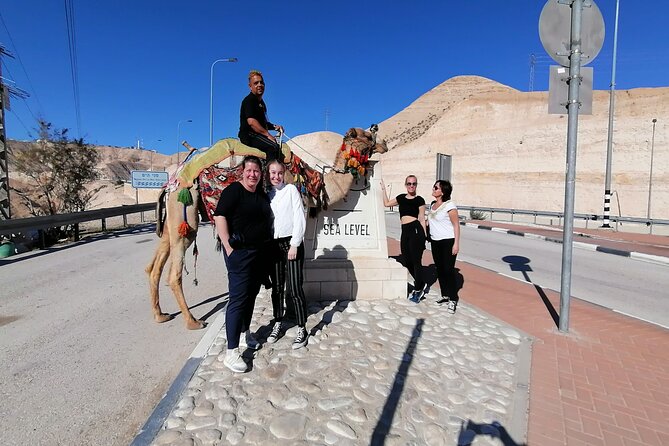
The contrast between the two parts of the day is important. Bethlehem is guided. Jericho and the Jordan River are self-guided. In Bethlehem, you can ask about the churches, hear explanations about the different traditions, and get help making sense of the underground chapels and biblical locations.
Elias receives especially warm praise for being informative, engaging, and very funny. Johnny and Saint George are also singled out for their guiding and people skills, while Amir is praised for the Jericho and Jordan River portion. Guides can change, so treat these names as useful examples rather than a promise.
The humor is not a trivial detail. A long day of sacred sites can become a blur of dates, saints, and grottoes. A guide who keeps the group alert can make the difference between a memorable visit and a weary march through stone corridors.
Jericho shifts from churches to ruins
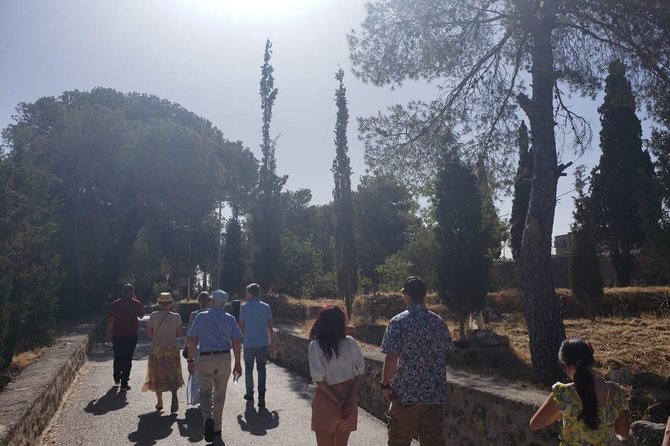
After Bethlehem, the route turns east toward Jericho. The pace changes here. There is no guided tour included for Jericho, so you should be ready to explore the stops with less structured explanation.
The first stop is the Monastery of Saint Gerassimos, also called Deir Hajla or Deir Hijleh. This Greek Orthodox monastery lies in the Jericho Governorate, west of the Jordan River and north of the Dead Sea. The scheduled visit is only 15 minutes, so think of it as a brief look rather than a full monastery tour.
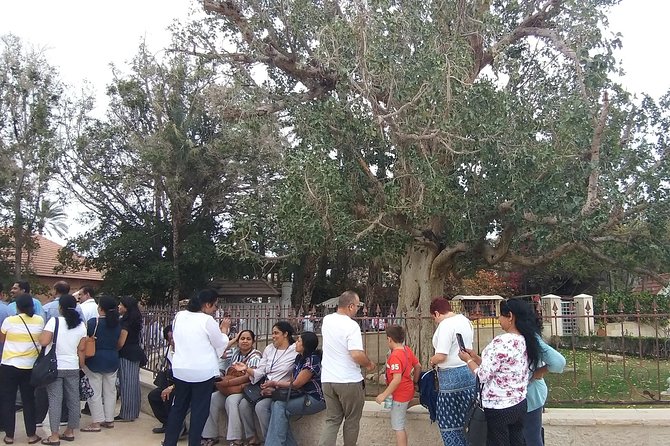
Next comes Zaccheus’ Tree, linked to the Gospel story of Zaccheus, a wealthy chief tax collector who climbed a sycamore tree to see Jesus because he was short. Jesus called him down and invited himself to Zaccheus’ home, prompting a sudden conversion.
The stop lasts about 15 minutes. The appeal is simple: you are seeing a physical marker connected to a familiar story, even if the visit itself is brief. It works best as a quick biblical orientation before the larger archaeological sites.
Hisham’s Palace and Tel es-Sultan
Hisham’s Palace is an early Islamic archaeological site from the Umayyad period in the first half of the eighth century. Located at Khirbat al-Mafjar, about five kilometers north of Jericho, it is one of the desert castles associated with the Umayyad dynasty.
You have about 30 minutes here, and admission is not included. The fee is listed as 10 Israeli shekels, so bring cash. The extra cost is small, but the need to pay separately can slow a group if people arrive unprepared.
This stop adds an important layer to the day. The route is not limited to Christian holy places. You also see evidence of early Islamic royal and administrative life, giving Jericho a wider historical frame.
Tel es-Sultan, also called Ancient Jericho or Tell Jericho, is another major archaeological stop. It lies about two kilometers north of modern Jericho and is identified as the site of ancient and biblical Jericho. The visit lasts about 30 minutes, with a separate admission fee of 10 shekels per person.
You should not expect a long archaeological lesson here. The time is enough to look around and understand the importance of the mound, but the self-guided format means you may need to read signs or use your own background knowledge. If archaeology is your priority, the short time and extra fee are worth noting.
A museum associated with the area displays archaeological remains, including Byzantine mosaics. One section explains the Samaritan community, its history, and customs. The schedule does not clearly state a separate museum visit, so ask the guide or driver if it is part of your departure.
The Mount of Temptation is deliberately left out
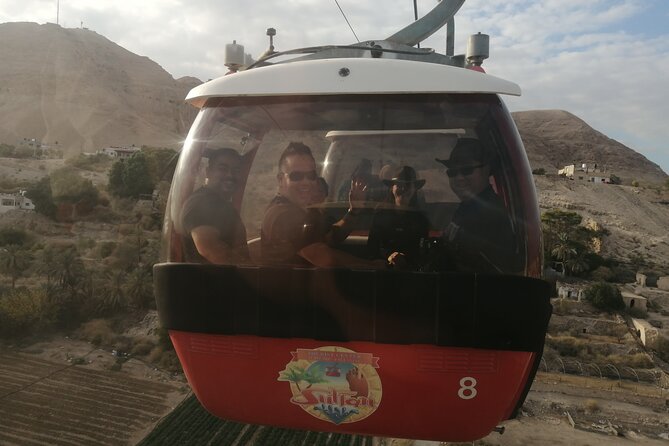
Jericho’s Mount of Temptation rises about three kilometers northwest of the city and overlooks the Jordan Valley. Christian tradition connects it with the 40 days and 40 nights Jesus spent fasting and reflecting after his baptism by John the Baptist.
This tour does not visit the mountain and does not include the cable car. That is worth stressing because the mountain is often associated with Jericho sightseeing. If the cable-car ride is a must for you, choose a different excursion or arrange it separately.
The omission also helps explain the tour’s value. At $80, the route concentrates on Bethlehem, selected Jericho sites, and Qaser Al Yahud rather than trying to include every attraction in the area. You get broad coverage, but not a full Jericho program.
Qaser Al Yahud and the Jordan River
Qaser Al Yahud, also spelled Qasr al-Yahud, is the final major stop. This is the Jordan River baptismal site, and the visit lasts about 30 minutes, with roughly 15 minutes at the river itself.
The stop is free according to the tour details. It is also self-guided, so do not expect the same level of explanation you receive in Bethlehem. The power of the place comes from its religious setting and the river itself, not from a long formal tour.
The short stay is sensible for a route already packed with sites. Still, you may find it too brief if you want quiet time by the water. The tour is designed to give you a meaningful look, not an extended retreat.
What the $80 price really covers
The $80 cost is reasonable if you value convenience and want all three areas in one day. You receive an air-conditioned vehicle, transport from central meeting points in Jerusalem or Bethlehem, and guided touring in Bethlehem.
You do not receive lunch. You also pay separately for Hisham’s Palace and Tel Jericho, each listed at 10 shekels, and you should carry cash for those entrances. The Jordan River and Bethlehem stops are listed without admission charges.
The biggest value is time saved. Organizing Bethlehem, Jericho, and Qaser Al Yahud independently would require careful transport planning and a willingness to manage several unfamiliar connections. The cost is less attractive if you dislike fixed schedules, large groups, or self-guided sightseeing.
The average booking lead time is about 15 days, which suggests you should not leave it until the last minute if your Jerusalem schedule is tight. Confirmation arrives at booking, and free cancellation is available until 24 hours before the start time. Changes or cancellations inside that window are not refunded.
Who should book this tour
I would recommend it to you if this is your first visit to the area and you want a broad introduction without arranging the transport yourself. It suits people who care about Christian sites but also want archaeology, early Islamic remains, and the Jordan River in the same day.
It is particularly good for:
- First-time visitors based in Jerusalem
- People who want a guided Bethlehem visit
- Travelers comfortable with a long shared coach day
- Visitors who want several major sites for one $80 transport package
- Anyone willing to carry cash and accept extra entrance fees
I would hesitate if you want a small private tour, long visits at each location, or a fully guided day. I would also hesitate if the Mount of Temptation and cable car are essential, since neither is included.
Final recommendation: book it for breadth, not leisure
This is a strong-value day for seeing Bethlehem, Jericho, and Qaser Al Yahud in one sweep. The best guiding is in Bethlehem, where the Church of the Nativity, St. Catherine’s, the Milk Grotto, and Shepherd’s Field gain meaning from clear local explanation.
Book it with realistic expectations. You may wait up to 90 minutes for the nativity grotto, Jericho is self-guided, the group may be large, and the Jordan River visit is short. Bring lunch money, cash for the 10-shekel Jericho admissions, and patience for a packed schedule.
If you want breadth, convenience, and strong Bethlehem storytelling, I would choose it. If you want a slow, deeply guided archaeological day or a visit to the Mount of Temptation, look for a more specialized option.
FAQ
How long does the tour last?
The full experience lasts approximately 8 to 11 hours.
What is included in the price?
The $80 price includes an air-conditioned vehicle and a guided tour in Bethlehem. Transport is provided from central meeting points in Jerusalem or Bethlehem.
Is lunch included?
No. Lunch is not included, so you should plan for your own midday meal.
Are Jericho and the Jordan River guided?
No. The Jericho and Jordan River portions are self-guided. The included guided tour is in Bethlehem.
How much are the Jericho entrance fees?
Hisham’s Palace is listed at 10 Israeli shekels, and Tel Jericho is also listed at 10 shekels per person. These fees are not included.
Does the tour visit the Mount of Temptation?
No. The tour does not visit the Mount of Temptation and does not take the cable car.
Just added around Jerusalem
- jerusalem classic tour★ 5.0 · 3 reviews
- Jerusalem and the Dead Sea★ 5.0 · 3 reviews
- Private Walking Tour in Jerusalem’s Old City★ 5.0 · 3 reviews
- Jerusalem of 3 Religions in Russian★ 4.4 · 3 reviews
- Jerusalem Running Tour-Experience the unique vibes of Jerusalem in your sneakers★ 5.0 · 3 reviews
- Christian Jerusalem in Russian★ 5.0 · 3 reviews
- From Jerusalem: Masada Sunrise, Ein Gedi & Dead Sea★ 5.0 · 3 reviews
- Hebron & Ramallah Full-Day Guided Tour from Jerusalem★ 5.0 · 3 reviews
Bethlehem & Jericho Day Trips, compared.
Day Tour to Jerusalem and Bethlehem from Tel Aviv
Read our review →
Jerusalem, Dead Sea, and Bethlehem from Tel Aviv
Read our review →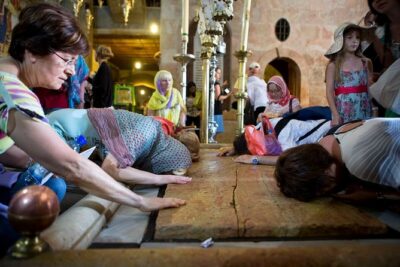
Jerusalem and Bethlehem Day Tour from Jerusalem
Read our review →
Travel to Bethlehem Half Day Guided Tour from Jerusalem & TelAviv
Read our review →
Ashdod Shore Excursion: Jerusalem and Bethlehem – for cruise ship guests only
Read our review →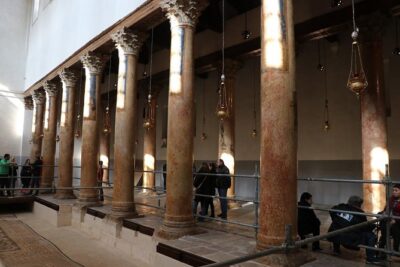
Travel From Jerusalem To Bethlehem and Dead Sea – Daily Group West Bank Tour
Read our review →Browse the lists this tour appears in