
Review · JAFFA OLD PORT TOURS
Discovering downtown Tel Aviv Street art and ancient Jaffa!
Art on the walls, history underfoot. This four-hour private walk links downtown Tel Aviv street art with the old port city of Jaffa, giving you two very different ways to understand Israel. I like the way guide Daniel Rozalis uses public art to discuss Israeli society, and I like the easy shift from modern Tel Aviv to Jaffa’s 3,000-year story.
The main consideration is that this is a walking experience, not a sightseeing trip by vehicle. You should also plan for your own meal, since lunch is not included, and remember that poor weather can lead to a change of date or a full refund.
In This Review
- Key points to know before booking
- Why this Tel Aviv and Jaffa combination works
- Reading Tel Aviv through street art
- Meeting Daniel Rozalis in modern Tel Aviv
- Walking from Tel Aviv toward 3,000-year-old Jaffa
- The final stop at Jaffa Flea Market
- Is $400 good value for a private group?
- Who will enjoy this walk most?
- Practical planning for the four-hour route
- Should you book Discovering downtown Tel Aviv Street Art and Ancient Jaffa?
- FAQ
- How long does the experience last?
- How much does the tour cost?
- Is the tour private?
- Who guides the tour?
- Where does the tour start?
- Where does the tour end?
- Is lunch included?
- Can I cancel for a full refund?
- What happens if the weather is poor?
Key points to know before booking
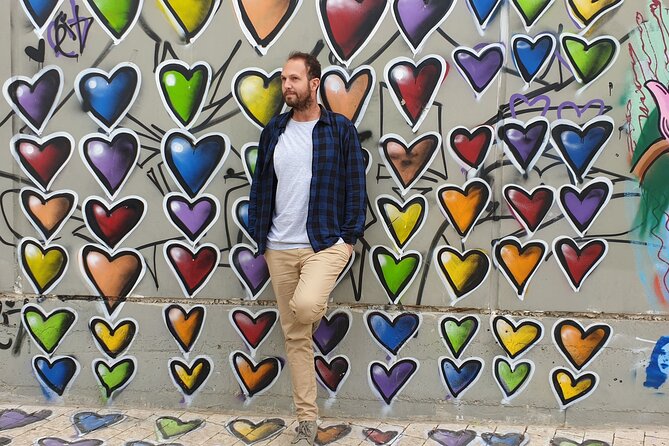
- Street art becomes a history lesson: Daniel uses murals, graffiti, erased images, and public symbols to explain Israeli society and current issues.
- Two cities in one walk: You move from modern downtown Tel Aviv to ancient Jaffa, a useful pairing for understanding how the cities connect.
- A genuinely private format: Your group alone takes part, with a maximum of 15 people and a licensed guide.
- Daniel Rozalis is central to the experience: His humor, organization, flexibility, and personal connection to Jaffa are repeated strengths of the tour.
- The route takes about four hours: Tel Aviv and Jaffa each receive roughly two hours, with the tour ending at Jaffa Flea Market.
- The $400 price covers the group: The value improves sharply with a larger party, since the fee does not increase for groups of up to 15.
Why this Tel Aviv and Jaffa combination works
Tel Aviv can feel young, fast, and outward-looking. Jaffa feels older, denser, and layered with religious and cultural stories. Seeing both on foot gives you a useful frame for the city instead of treating them as unrelated stops.
The tour begins in downtown Tel Aviv with street art. This is not just a photo walk. Daniel uses the art to ask questions about Israeli society, public debate, authority, memory, and trauma. After that, you walk a short distance toward Jaffa, where the subject changes from current social questions to thousands of years of port-city history.
I like this order. The first half gives you a way to read modern Israel. The second gives you the long view. By the time you reach Jaffa, you are not simply looking at old buildings. You are considering how an ancient port and a modern city exist side by side.
Because the activity is private, Daniel can adapt the pace and focus to your group. That matters here. Street art can appeal to people who do not normally book a history tour, while Jaffa’s religious and archaeological stories can appeal to people who prefer traditional sightseeing. A flexible guide helps bridge those interests.
More of old Jaffa on foot:
- Tel Aviv Jaffa Guided Bike Tour
★ 4.5 · 178 reviews - Tel Aviv: Jaffa Half-Day Walking Tour
★ 4.5 · 70 reviews - Tel Aviv: Jaffa & Carmel Market Walking Tour
★ 4.7 · 60 reviews
Reading Tel Aviv through street art
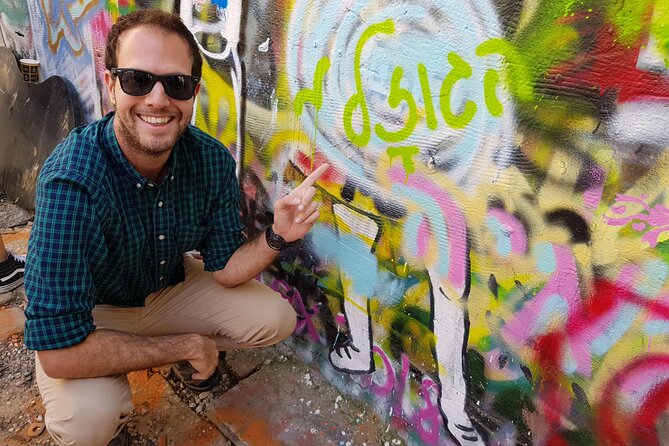
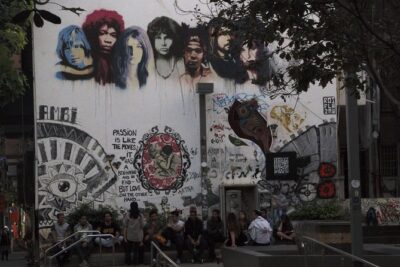
The Tel Aviv portion lasts about two hours and is built around downtown street art. You will walk through the city while Daniel explains how artists use walls and public spaces to express ideas, challenge authority, preserve memory, or provoke a reaction.
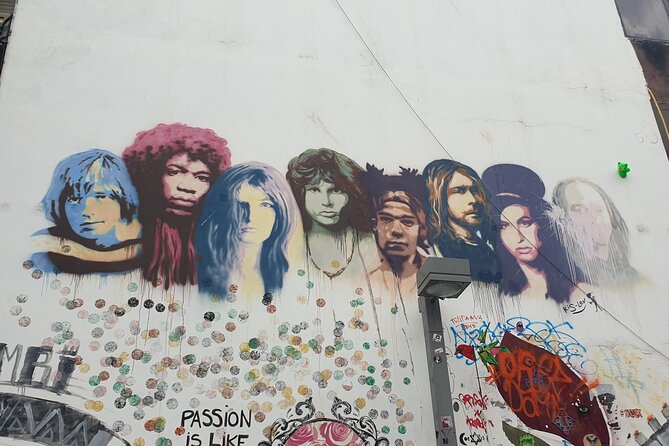
Several of the questions raised on this part are unusually specific. You may learn about the oldest graffiti in the city, examine why a figure connected with the 27 Club was erased, and consider how artists paint without being caught by authorities. These details give the walk a practical edge. You are not only asking who made a mural or when it appeared. You are also thinking about ownership, censorship, risk, and the temporary nature of art in public spaces.
The tour also connects street art with mental health through the question of whether a band-aid can help with PTSD. That kind of subject makes the walk more than a collection of colorful walls. The art becomes a prompt for difficult conversations about personal and national experience.
I appreciate that this approach gives you something to look for after the tour ends. You may notice that a wall is not simply decoration. It can be an argument, a memorial, a joke, an act of defiance, or a mark of who feels entitled to use public space.
The art also photographs well, which is a useful bonus, but pictures are not the main point. The value comes from knowing what you are looking at and why it matters. Without explanation, street art can pass quickly. With a guide who can connect it to Israeli life, the same wall can carry much more weight.
The wording of the experience suggests that this section can also be taken on its own or combined with a Jaffa visit. The full four-hour version is the stronger choice if you have the time, since the contrast between the two areas is one of the tour’s main attractions.
Meeting Daniel Rozalis in modern Tel Aviv
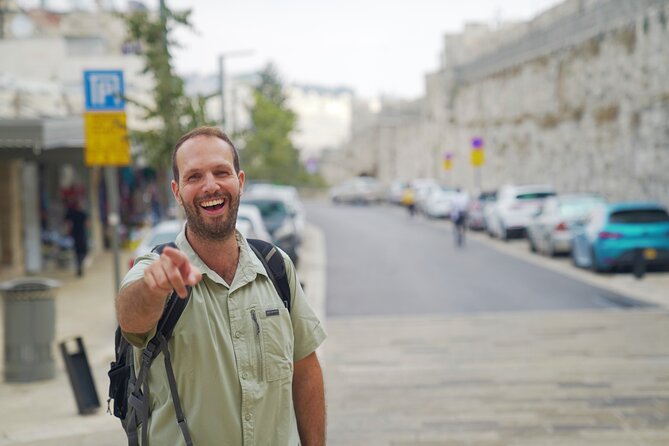
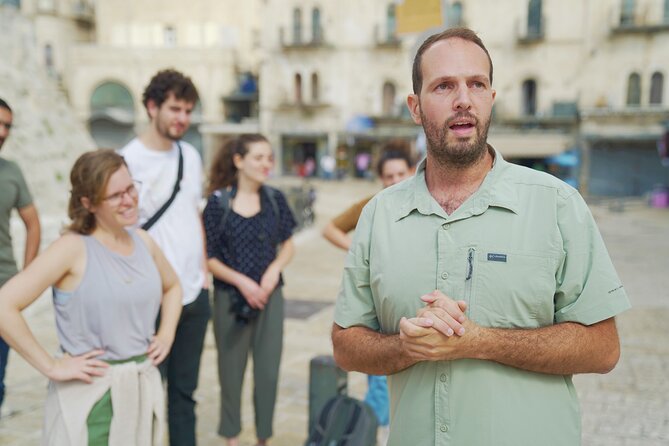
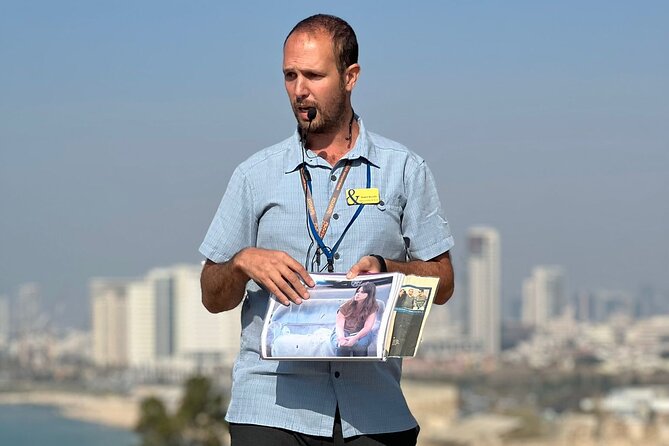
Daniel Rozalis is the licensed guide leading the experience. His connection to Jaffa is personal: he lives there and calls it home. That gives the second half of the walk a local connection, while his work with groups across Israel gives him a wider setting for history and culture.
The strongest pattern in the available feedback is Daniel’s manner. He is described as funny, warm, organized, enthusiastic, and flexible. One particularly useful detail is his willingness to change the plan around a group’s needs and preferences. For a private tour, that flexibility is not a small extra. It is one of the main reasons to pay for a private format.
You should still tell Daniel what interests your group when you book or meet. The experience covers sensitive and sometimes complicated subjects, including Israeli society and current issues. A private group gives you room to ask questions, request more context, or spend longer with a subject that catches your attention.
The feedback also points to Daniel’s ability to make the experience feel personal rather than formal. People describe him as friendly and humorous, with the warmth of someone showing a city to friends. That style will suit you if you prefer conversation and interpretation over a fixed speech.
If you want a silent walk with only dates and architectural facts, this may not be the best match. The tour is designed around discussion, personal insight, and questions. That is a strength for curious groups, but a possible mismatch for anyone who wants a strictly scripted route.
Walking from Tel Aviv toward 3,000-year-old Jaffa
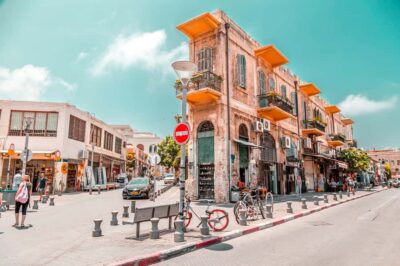
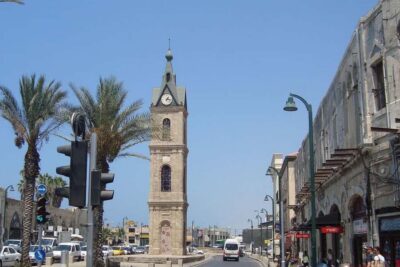
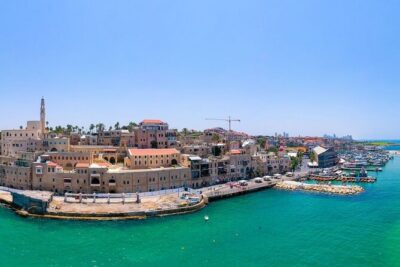
After the Tel Aviv section, the group walks a short distance to ancient Jaffa. The change in mood is part of the experience. You leave behind the modern city’s street-level expressions and enter a place presented as a 3,000-year-old port city.
Jaffa’s importance comes from its long connection with the sea, trade, religion, and migration. The tour focuses on the contrast between modern Jaffa and its older layers, as well as the interaction between Jewish and Arab communities. The goal is not to flatten Jaffa into one story. Instead, you look at how different histories and identities occupy the same place.
The biblical material adds another layer. Daniel covers Peter’s vision in Jaffa, referenced in Acts 10:9, along with the story of Jonah and the large fish. These are familiar stories to many people, but seeing them connected to a real port city gives the tales a physical setting.
You should expect this section to move between biblical stories, local history, modern life, and the city’s market culture. That range is useful, though it also means the tour cannot provide an exhaustive account of every period in Jaffa’s past. Think of it as an interpretive introduction, not a specialist archaeology course.
The tour continues toward the Jaffa Flea Market, where the old-city experience meets modern commerce. This is a good ending point because it brings the story back into everyday life. Jaffa is not only a historical site. It is also a lived-in part of the Tel Aviv area, with shopping, street activity, and a modern Jewish and Arab presence.
A few more Tel Aviv trips worth weighing up
- Tel Aviv Street Art & Graffiti Tour
★ 5.0 · 76 reviews - Tel Aviv: Street Art and Graffiti Tour
★ 5.0 · 36 reviews - Tel Aviv Street Art Tour
★ 4.0 · 23 reviews
The final stop at Jaffa Flea Market
The tour ends at Jaffa Flea Market on Olei Zion Street. That makes the market a practical place to continue your day, browse on your own, or stop for food after the guide’s portion ends.
Lunch is not included, so you should plan around that. You can eat before the tour, carry what you need, or make the market area your next stop. Since the route lasts about four hours, food planning matters, especially if you are traveling with children or anyone who does better with regular meal breaks.
The end point also differs from the start at Elifelet Street 18 in Tel Aviv-Yafo. You should allow time for the return journey from Jaffa after the tour, rather than assuming you will finish where you began. The meeting and ending points are near public transportation, which helps with that onward travel.
The available hours are listed as 8:00 a.m. to 6:00 p.m., Monday through Sunday, for the stated operating period. Your confirmed booking remains the important detail, since confirmation is provided within 48 hours and depends on availability.
Is $400 good value for a private group?
The price is $400 per group of up to 15 people. That is expensive for one or two people, but it can be strong value for a family, group of friends, or organized party.
At the maximum group size, the cost works out to about $27 per person. For a group of eight, it is $50 each. For two people, the full group price is $200 per person, so a smaller party should think carefully about whether the private format is worth the premium.
You are paying for four hours with a licensed guide and for a route that combines two different subjects. The private structure also means you are not sharing the experience with strangers, and Daniel can adjust the discussion to your interests. Those benefits matter more if your group enjoys asking questions or has mixed interests.
I would not choose this tour mainly to save money. I would choose it for the format. A standard group walk may cost less, but it may not give you the same ability to change the pace or shape the conversation. If you have a full group, the pricing becomes much easier to justify.
Who will enjoy this walk most?
I would recommend this experience to you if you want more than a list of famous sights. It suits people who enjoy social questions, visual culture, local stories, and the chance to talk directly with a guide.
It is also a smart choice for a first visit to Tel Aviv and Jaffa because it establishes a clear contrast between the two areas. You get an introduction to modern Tel Aviv, then a separate way to understand Jaffa’s age, faith traditions, and mixed cultural identity.
The tour may be especially useful for:
- Families or friends who want a private outing
- Groups with up to 15 people
- People interested in graffiti, murals, and public art
- Visitors who want both Tel Aviv and Jaffa in one half-day
- Anyone who prefers a warm, conversational guide
- Groups that want some flexibility in the route and discussion
You should think twice if your priority is indoor sightseeing, a vehicle-based tour, or a meal included in the price. The weather requirement also matters. If conditions are poor, the activity may be moved to another date or canceled with a full refund.
Most people can participate, and service animals are allowed. The tour is near public transportation, but the provided information does not describe the walking distance, stair access, or exact surface conditions. If someone in your group has mobility concerns, ask Daniel for route details before booking.
Practical planning for the four-hour route
Start at Elifelet Street 18 in Tel Aviv-Yafo and make sure everyone knows the tour finishes at Jaffa Flea Market. A mobile ticket is provided, and confirmation arrives within 48 hours if space is available.
Wear comfortable shoes and plan for several hours on foot. That advice follows the structure of the experience: two hours in downtown Tel Aviv, a short walk between areas, and two hours in Jaffa.
Leave room in your schedule after the tour. The flea market is the final point, and you may want to eat, shop, or continue exploring from there. Rushing away at the exact end would waste the advantage of finishing in such a useful part of Jaffa.
The cancellation policy is friendly if your plans change early. You can receive a full refund by canceling at least 24 hours before the local start time. Changes or cancellations inside that 24-hour window are not accepted for a refund.
Should you book Discovering downtown Tel Aviv Street Art and Ancient Jaffa?
I would book it if you want a private, discussion-based introduction to Tel Aviv and Jaffa, especially if your group is large enough to share the $400 cost. The strongest reason to go is the pairing of street art and old Jaffa, guided by Daniel Rozalis, whose humor, warmth, organization, and connection to the area shape the experience.
I would skip it if you want a short sightseeing loop, included food, or a fully predictable script. For everyone else, this is a thoughtful way to see how modern Israeli life appears on city walls, then connect those current questions to Jaffa’s long religious and port-city story.
FAQ
How long does the experience last?
The full experience lasts approximately four hours. The Tel Aviv street-art portion takes about two hours, followed by about two hours in Jaffa.
How much does the tour cost?
The price is $400 per private group of up to 15 people.
Is the tour private?
Yes. Only your group participates, with no other groups joining the activity.
Who guides the tour?
The experience is led by licensed tour guide Daniel Rozalis.
Where does the tour start?
The meeting point is Elifelet Street 18 in Tel Aviv-Yafo, Israel.
Where does the tour end?
The tour ends at Jaffa Flea Market on Olei Zion Street in Tel Aviv-Yafo.
Is lunch included?
No. Lunch is not included in the tour price.
Can I cancel for a full refund?
Yes. You can cancel at least 24 hours before the local start time for a full refund.
What happens if the weather is poor?
If the experience is canceled because of bad weather, you will be offered another date or a full refund.
Just added around Tel Aviv
- 4-Day Christian Israel Tour from Tel Aviv★ 5.0 · 3 reviews
- Palm Sunday in Jerusalem: Mass at Bethpage and Via Dolorosa Procession with Transport from Tel Aviv★ 5.0 · 3 reviews
- Tel Aviv to Tel Aviv Airport (TLV) – Departure Private Transfer★ 5.0 · 3 reviews
- Masada and Dead Sea from Tel Aviv★ 4.5 · 3 reviews
- Jerusalem and Dead Sea Tour from Tel Aviv★ 4.5 · 3 reviews
- Private Transportation From / To Ben Gurion Airport to Tel Aviv Hotels★ 5.0 · 3 reviews
- Tel Aviv: Carmel Market & Neighborhood Guided Walking Tour★ 4.7 · 3 reviews
- Holyland Tour :Jerusalem & Bethlehem from Jerusalem or Tel Aviv★ 5.0 · 3 reviews
Jaffa Old Port Tours, compared.


Browse the lists this tour appears in