
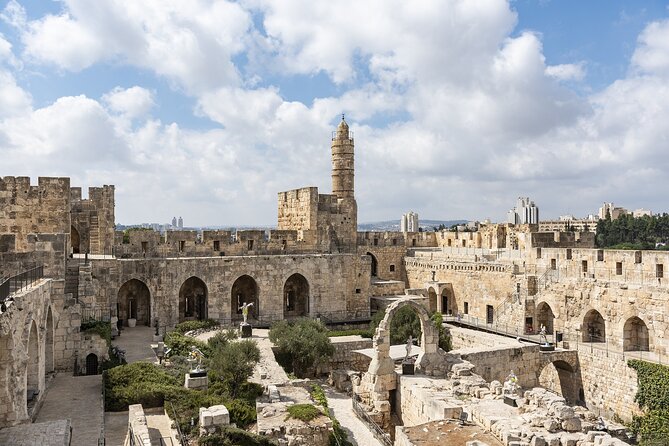
Review · DEAD SEA TOURS
Jerusalem & Dead Sea Private Tour – Visit Holy Jerusalem & Dead Sea Relaxation
Two icons, one very long day. This private trip links Jerusalem’s sacred Old City with a float in the Dead Sea, a smart choice if your Israel schedule is tight. I like the private vehicle and hotel pickup, which remove much of the day’s transport hassle, and I like the chance to see Christian, Jewish, and Roman sites with a guide rather than simply racing between photo stops. The main drawback is the pace: Jerusalem alone can fill a day, and adding the Dead Sea means limited time at both.
The tour is advertised at about 8 to 11 hours, while the overview describes a 12-hour day. Either way, expect an early start and a late return. At $220 per person, it is not a cheap outing, but the price buys a private group, a licensed guide, air-conditioned transport, and a broad route that would be awkward to arrange independently in one day.
In This Review
- Key points to know before booking
- Why this Jerusalem and Dead Sea combination works
- Mount of Olives: the right opening view
- Garden of Gethsemane and Mount Zion
- Walking the Via Dolorosa to the Holy Sepulchre
- The Cardo and Western Wall
- The drive to the Dead Sea
- Floating and mud at the Dead Sea
- The guides and the private vehicle
- Is $220 per person a fair price?
- Who should book this day?
- Should you book the Jerusalem and Dead Sea private tour?
- FAQ
- How long does the tour last?
- Is hotel pickup and drop-off included?
- Is this a private tour?
- What transport is provided?
- Are food and drinks included?
- What should I bring?
- Can I cancel for a full refund?
Key points to know before booking
- Mount of Olives first: Begin with one of Jerusalem’s best city views before walking into the Old City.
- Three faith traditions in one morning: The route includes Christian sites, Jewish holy places, and Roman-era remains.
- Private means flexible: Only your group participates, so your guide can adjust explanations and the rhythm of the day.
- The Dead Sea is a true change of pace: After several hours on foot, you get time to float and try mineral-rich mud.
- Guiding is a major part of the value: Enrique, Benjamin, and Saul are among the guides praised for humor, history, organization, and care.
- Check the fee details: The highlights say entrance fees are included, but the inclusion list says they are not. Confirm this before paying.
Why this Jerusalem and Dead Sea combination works
Jerusalem and the Dead Sea are both essential stops, but they offer very different experiences. Jerusalem asks for attention, walking, and patience. The Dead Sea asks you to sit back, float, and let the water do the odd work of keeping you upright.
That contrast is the best reason to book this trip. You start with views and sacred places, spend the middle of the day among tight stone lanes and major religious sites, then finish beside a broad salt lake below sea level. It gives you a strong first look at central Israel without asking you to change hotels.
The private format matters here. A large group can lose time gathering at corners, waiting for late arrivals, or keeping every person on the same script. With only your own party, you can ask more questions about Jewish, Christian, and Roman history, or request a little more time at a place that matters to you.
Still, you should keep your expectations sensible. This is a sampler, not a slow study of Jerusalem. The listed stops add up to several hours before driving time, and the roads between Tel Aviv or Herzliya, Jerusalem, and the Dead Sea take a large share of the day. You will see a lot, but you will not linger everywhere.
More ways to get down to the Dead Sea:
- From Tel Aviv: Masada & Dead Sea Full Day Tour with Pick Up
★ 4.5 · 1,496 reviews - Masada and the Dead Sea Day Trip from Tel Aviv
★ 4.5 · 1,014 reviews - Tel Aviv: Jerusalem, Bethlehem & Dead Sea
★ 4.0 · 881 reviews
Mount of Olives: the right opening view
The first stop is the Mount of Olives, with about 30 minutes for a panoramic look at Jerusalem. This is a good way to get your bearings. From above, the Old City, Temple Mount, and the Judean Desert can be understood as parts of one dramatic setting rather than a jumble of sacred names.
The hill also carries major Christian meaning. It is linked in the New Testament with Jesus’ route toward Bethany, his grief over Jerusalem, and his ascension. Your guide can connect the view to those traditions while also explaining the hill’s place beside the Temple Mount and the desert.
Thirty minutes is enough for the main view and an introduction, but not for a long quiet visit. Bring a hat and sunscreen. Morning light can be sharp, and the open viewpoint offers little relief from the sun.
Garden of Gethsemane and Mount Zion
At the foot of the Mount of Olives, the Garden of Gethsemane brings the day closer to the Christian story. The garden is associated with Jesus’ agony and arrest before the crucifixion. Several small olive groves on church property are identified with biblical Gethsemane, so your visit is best understood as a place of long religious tradition rather than a site with one universally confirmed patch of ground.
The planned visit lasts about 30 minutes. That gives you time to see the olive groves and nearby church property, but the stop may feel brief if you want a quiet moment for prayer or reflection.
Mount Zion follows, with about an hour for King David’s Tomb and the Room of the Last Supper. King David’s Tomb is deeply sacred to Jewish visitors, though the exact burial location is not certain. The biblical account places David’s burial in the City of David, below the Temple Mount, an important detail if you want the guide to separate tradition from firm archaeological proof.
Above the tomb, the Room of the Last Supper, also called the Cenacle, is linked by Christian tradition to the Last Supper. The room’s importance comes from that tradition, and its position on Mount Zion makes this a useful stop for understanding how different religious memories overlap in Jerusalem.
This part of the day is especially suited to people who enjoy history with some room for discussion. The sites are not simply photo opportunities. They raise questions about tradition, archaeology, scripture, and the way several faiths share the same city.
Walking the Via Dolorosa to the Holy Sepulchre
The Christian Quarter is where the tour becomes most physical. You walk along the Via Dolorosa, the narrow processional route associated with Jesus’ path to crucifixion, and continue to the Church of the Holy Sepulchre.
Allow about two hours for this section, including the walk and the church. Wear comfortable shoes. The Old City lanes are made for walking, not for easy strolling, and the stone surfaces can make the distance feel longer than it looks on a map.
The Via Dolorosa is not a quiet museum corridor. It is a working part of the Old City, lined with lanes, shops, and daily activity. That can make the experience feel less solemn than you imagined, but it also shows Jerusalem as a living city rather than a preserved religious display.
The Church of the Holy Sepulchre is the central Christian stop of the day. It is traditionally associated with Jesus’ crucifixion, burial, and resurrection. Within the church, Calvary, or Golgotha, is linked to the crucifixion site.
Your guide’s explanation is particularly useful here because the church can feel confusing at first. Several Christian traditions share responsibility for the building, and the spaces carry different meanings. One hour is enough to visit the main areas, but lines and religious services can affect how much time you have inside.
Modest dress is required at holy sites, and a head covering is required according to the tour guidance. Pack clothing that covers shoulders and knees, even if the rest of your day will be hot and casual.
A few more Tel Aviv trips worth weighing up
- Dead Sea Relaxation Day from Tel Aviv
★ 4.0 · 40 reviews - From Tel Aviv: Full-Day Dead Sea Relaxation Tour
★ 4.6 · 9 reviews - Dead Sea Relaxation & Bedouin hospitality – Tiny group from Tel Aviv
★ 5.0 · 3 reviews - Private Couple Massage workshop
★ 5.0 · 3 reviews
The Cardo and Western Wall
After the Christian Quarter, the route continues through the Armenian and Jewish quarters to the Cardo. This restored Roman road gives you a different window into Jerusalem. The southern section was uncovered in the Jewish Quarter and dates to the reign of Byzantine emperor Justinian, from 527 to 565, while the northern section is Roman.
The stop is planned for about 30 minutes. I would treat it as a compact history lesson rather than a full archaeological visit. The Cardo helps explain how Jerusalem was organized in the Roman and Byzantine periods, and how modern excavations have exposed old layers beneath the current city.
The Western Wall, also called the Kotel, is the final major Jerusalem stop. You get about 30 minutes there. The wall is part of a much longer ancient retaining wall near the Temple Mount and is the holiest place where Jews are permitted to pray, given the restrictions on entering the Temple Mount.
The visit calls for respect and awareness. This is an active place of prayer, not simply an ancient monument. Men and women may use separate prayer areas, and you should follow local signs and your guide’s instructions. Avoid treating worshippers as scenery, and keep photography discreet.
The short time here can be enough to see the wall and understand its importance, but it is not enough for a long visit during a busy prayer period. This is one place where the private format helps, since your guide can explain what is happening without making the whole group wait.
The drive to the Dead Sea
Once you leave Jerusalem, the day changes character. The road runs through the Judean hills toward the Dead Sea, also known as the Sea of Salt. The water lies in the Jordan Rift Valley between Jordan and the West Bank and is the lowest place on earth.
The drive is part of the experience, even though the tour description does not assign it a separate sightseeing stop. You move from Jerusalem’s dense stone quarters into a dry, open region. Your guide may use the journey to add context about the area, but you should not expect a full desert tour unless that has been arranged separately.
This transfer also explains why the day feels long. You are covering a wide area by road after several hours of walking. The air-conditioned vehicle is not a minor extra here. It gives you a place to rest, cool down, and keep your belongings while the guide handles the driving and route.
Food and drinks are not included, so bring water and plan for your own meal or snacks. The supplied information does not specify a lunch stop, so do not assume a restaurant meal is built into the schedule.
Floating and mud at the Dead Sea
At a Dead Sea resort, you get about two hours to relax, float, and try the mineral-rich mud. This is the easygoing part of the day, but it comes with a few practical rules.
The water’s high salt content makes floating unusually easy. You do not need to be a strong swimmer, though you do need to follow the resort’s safety instructions. Do not shave immediately before the visit, since salt water can sting irritated skin, and keep the water away from your eyes and mouth.
The mud bath is optional. It is included as an opportunity, not a requirement, so you can float, sit by the shore, or simply rest after Jerusalem. Bring a towel, sunglasses, sunscreen, and a hat. A towel is specifically recommended, but it is not listed as included.
Two hours gives you a worthwhile taste of the Dead Sea, but not a full spa day. You are visiting a resort for a short stop before returning to your pickup point. If your main goal is a long, leisurely Dead Sea retreat, book a separate overnight stay or a dedicated beach day instead.
The guides and the private vehicle
The strongest part of this experience is the guiding. Enrique is praised for clear commentary, humor, and strong command of Israeli history and theology. Benjamin is noted for being punctual, dependable, kind, and a capable driver, while Saul is praised for careful timing, detailed explanations, and a warm manner with families.
Guide quality matters more in Jerusalem than in many sightseeing cities. The same stone, tomb, wall, or chapel can carry several meanings, and a good guide helps you understand the differences without turning the day into a sermon or a list of dates.
The air-conditioned vehicle also earns its keep. Jerusalem’s walking sections can be tiring, and the transfer to the Dead Sea is long enough that comfort affects the whole day. Hotel pickup and drop-off are included, which is useful if you are staying in Tel Aviv or Herzliya and do not want to navigate an early intercity departure.
The information describes pickup from Herzliya in one place and lists Tel Aviv as the location, so confirm your exact pickup area when booking. The tour is private, and only your group participates.
Is $220 per person a fair price?
At $220 per person, this tour is best judged against what it replaces. You are paying for a full-day private outing, a licensed professional guide, hotel pickup and drop-off, and an air-conditioned vehicle. You also avoid arranging separate transport between Tel Aviv, Jerusalem, and the Dead Sea.
For a couple or small family that values privacy and convenience, the price can make sense. The guide’s ability to explain the sites in your preferred depth is a real part of the value. A private vehicle also lets you rest between stops instead of managing several transport connections.
The value is weaker if you want a slow Jerusalem visit, a long Dead Sea session, or a low-cost independent day. The tour covers a lot of ground, but the schedule leaves little spare time. Also, the information is inconsistent about entrance fees. The highlights say all entrance fees are included, while the inclusion list says entrance fees are not included. Ask Compass Travel Israel to clarify this exact point before booking.
Free cancellation is available if you cancel at least 24 hours before the start time. Changes or cancellations inside that window are not accepted for a refund.
Who should book this day?
I would recommend this tour to first-time visitors with one free day, families that want a private guide, and people who would rather pay for an organized route than manage buses, taxis, and timing. It also suits visitors who want religious context but do not want to spend their entire trip on church visits.
It is less suitable for anyone who dislikes early starts, long drives, or tight schedules. Travelers with limited mobility should ask about the walking sections before booking, since the route includes the Via Dolorosa and several Old City quarters. The tour says most participants can take part, but it does not promise a step-free route.
Bring:
- Comfortable walking shoes
- Modest clothing and a head covering for holy sites
- Hat, sunglasses, and sunscreen
- Towel for the Dead Sea
- Water and money for food and personal expenses
Should you book the Jerusalem and Dead Sea private tour?
Book it if you want maximum coverage in one day and value a private guide who can bring order to Jerusalem’s complicated religious and political story. The combination of Mount of Olives views, the Holy Sepulchre, the Western Wall, Roman remains, and Dead Sea floating is hard to match in a single organized outing.
Skip it if you have two free days. Give Jerusalem a full day, then visit the Dead Sea at a slower pace. But if your Israel trip is short, this is a practical, well-supported choice, provided you confirm the pickup location, final duration, and entrance-fee policy before paying.
FAQ
How long does the tour last?
The experience is listed as approximately 8 to 11 hours, while the overview describes a 12-hour day. Confirm the expected return time when booking.
Is hotel pickup and drop-off included?
Yes. Hotel pickup and drop-off are included, with the tour information referring to pickup from the Tel Aviv and Herzliya area.
Is this a private tour?
Yes. Only your group participates in the activity.
What transport is provided?
The tour includes an air-conditioned vehicle and a government-licensed professional tour guide.
Are food and drinks included?
No. Food and drinks are not included, so you should plan and pay for them yourself.
What should I bring?
Comfortable walking shoes, a hat, towel, sunglasses, and sunscreen are recommended. Modest dress and a head covering are required for visits to holy sites in Jerusalem.
Can I cancel for a full refund?
Yes, if you cancel at least 24 hours before the experience start time. Cancellations or changes made less than 24 hours before the start time are not accepted for a refund.
Just added around Tel Aviv
- 4-Day Christian Israel Tour from Tel Aviv★ 5.0 · 3 reviews
- Palm Sunday in Jerusalem: Mass at Bethpage and Via Dolorosa Procession with Transport from Tel Aviv★ 5.0 · 3 reviews
- Tel Aviv to Tel Aviv Airport (TLV) – Departure Private Transfer★ 5.0 · 3 reviews
- Masada and Dead Sea from Tel Aviv★ 4.5 · 3 reviews
- Private Transportation From / To Ben Gurion Airport to Tel Aviv Hotels★ 5.0 · 3 reviews
- Jerusalem and Dead Sea Tour from Tel Aviv★ 4.5 · 3 reviews
- Tel Aviv: Carmel Market & Neighborhood Guided Walking Tour★ 4.7 · 3 reviews
- Holyland Tour :Jerusalem & Bethlehem from Jerusalem or Tel Aviv★ 5.0 · 3 reviews
Dead Sea Tours, compared.
Masada & Dead Sea Full Day Tour with Pick Up
Read our review →
Masada and the Dead Sea Day Trip from Tel Aviv
Read our review →
Masada and the Dead Sea Day Trip from Jerusalem
Read our review →
Browse the lists this tour appears in