
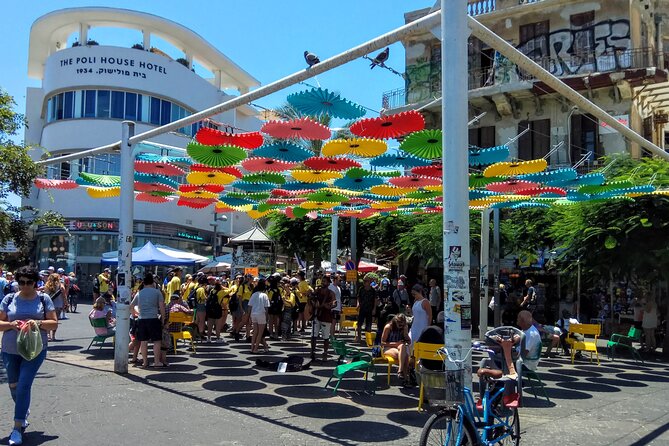
Review · FOOD & DRINK
Urban Walking & Food Tour in Tel Aviv
Tel Aviv tells its story on foot. I like the way this five-hour tour links Bauhaus architecture with the city’s founding streets, then shifts into Neve Tzedek, Carmel Market, and Kerem HaTeimanim. I also like the small-group format and guide Menno’s personal, enthusiastic approach. The main caution is the food arrangement: the highlights describe lunch as included, while the practical details say food and drinks cost about $40 per person.
This is a city orientation with food tucked into it, not simply a market crawl. You’ll walk from Habimah Square at 10:00 a.m. and finish at Carmel Market, covering a great deal of central Tel Aviv. Wear good walking shoes, bring water, and confirm the final group size and meal inclusions before paying.
In This Review
- Key points to know before booking
- Tel Aviv in one morning, from theatre square to market lane
- Small stops with large stories along Rothschild
- Migdal Shalom and the city before the skyscrapers
- Neve Tzedek, where old homes meet new style
- Park HaMesila and the city’s changing infrastructure
- Carmel Market and Kerem HaTeimanim, the food center of the day
- What the guide adds to the five-hour walk
- Price, group size, and what you actually receive
- Who will get the most from this Tel Aviv tour
- Should you book this Tel Aviv walking and food tour?
- FAQ
- Where does the tour start?
- Where does the tour end?
- How long does the tour last?
- Is lunch included?
- Is this a private tour?
- Can I cancel for a full refund?
Key points to know before booking
- A five-hour route with a clear story: Follow Tel Aviv from its early Jewish neighborhoods to its modern streets and light-rail projects.
- Rothschild Boulevard is the historical spine: See the Founders Monument, Bauhaus buildings, Ahuzat Bayit, and the former home of Meir Dizengoff.
- Neve Tzedek adds a different mood: Low-rise historic homes now sit beside design shops, cafés, and restaurants.
- Carmel Market gets the most time: The itinerary allows one hour and 45 minutes for food, shopping, and neighborhood exploration.
- Menno is a major part of the experience: His background and enthusiasm help connect architecture, immigration, politics, and daily life.
- Check the price details carefully: The listed cost is $500 per private group of up to six, while food is separately described as about $40 per person.
Tel Aviv in one morning, from theatre square to market lane
The route begins at Habimah Theatre at 10:00 a.m. This is a useful starting point because several major streets meet at Habimah Square, including Rothschild Boulevard, Hen Boulevard, Dizengoff Street, and Ben-Zion Boulevard.
The square is home to Israel’s national theatre, one of the country’s first Hebrew-language theatres. You spend only about 10 minutes here, but the stop sets up an important theme: Tel Aviv is a young city with a strong interest in building a Hebrew public culture.
From there, the walk follows Rothschild Boulevard for about 30 minutes. This is the city’s first boulevard and one of its best places to understand Tel Aviv’s early development. The name comes from a member of the wealthy Rothschild family, whose support helped Jewish settlement projects in the region.
The real attraction is the architecture. Many buildings along and near the boulevard use the Bauhaus or International style, with clean lines and practical forms. Together, these structures helped Tel Aviv earn its White City nickname. You will not simply look at façades. The guide uses them to explain how the city grew, how modern design became useful in a hot climate, and why this part of Tel Aviv feels different from older Jaffa.
The walk makes short side trips but returns to Rothschild Boulevard until it reaches Ahuzat Bayit, the first neighborhood of Tel Aviv. That progression is one of the route’s best features. You can watch the city move from planned beginnings to offices, cafés, apartment buildings, and modern public works without needing a bus or a long transfer.
More Walking Tours in Tel Aviv
- Walking Tour of Akko (Half-day)
★ 5.0 · 84 reviews - Tel Aviv: Jaffa Half-Day Walking Tour
★ 4.5 · 70 reviews - Tel Aviv: Florentin Saturday Walking Tour
★ 3.5 · 65 reviews
Small stops with large stories along Rothschild
Several brief stops follow, each lasting around five minutes. They may seem quick, but they give the walk a strong historical rhythm.
At King Albert Square, near Nachmani Street 23, you see the Norman Hotel and the Pagoda House. The Norman is a major boutique hotel, while the Pagoda House shows a more eclectic architectural style. I like this contrast because it reminds you that Tel Aviv is not only a Bauhaus city. Its buildings mix modernist design with decorative and unusual forms.
Beit Levin is known by several nicknames, including the Castle and the KGB House. The guide explains where those names came from. Since you spend only about five minutes here, this is more of a street-side story than a full architectural visit.
On Yehuda Ha-Levi Street, the tour points out a station connected with the new Tel Aviv light rail. That detail brings the walk into the present. Tel Aviv is not treated as a museum of old buildings. Its streets are still being rebuilt and reorganized, and the light rail is part of that ongoing change.
The Tel Aviv Great Synagogue is another quick but worthwhile stop. It is large, yet easy to miss if nobody points it out. The synagogue was planned by the city’s founders but built years after their original neighborhood. That gap between ambition and completion says a lot about how slowly major public projects can develop.
At the Founders Monument and Fountain, you learn how Jewish families contributed money to create a modern neighborhood that became Tel Aviv. It is a small place with an important civic message. The city was not simply imposed from above. Local families helped fund its creation.
The statue of Meir Dizengoff, Tel Aviv’s first mayor, sits on horseback outside his former home. This address also carries national importance. In 1948, David Ben-Gurion declared the new Jewish state there, after a Jewish state had been absent for about 2,000 years. The stop connects municipal history with the founding moment of Israel.
Migdal Shalom and the city before the skyscrapers
Migdal Shalom offers a sharp change in scale. Built on the site of HaGymnasia, the first Hebrew high school, it was the first skyscraper in the Middle East.
You spend about 15 minutes here, longer than at most of the preceding stops. That makes sense. The building represents the point where Tel Aviv began reaching upward, replacing some of its low-rise character with a modern commercial center.
At Herzl Street 2, the tour introduces the house of Akiva Weiss, who initiated the building of Tel Aviv. You also see a statue of Alfred Dreyfus, the Jewish captain in the French army whose unjust prosecution became a major symbol of antisemitism and legal injustice.
Dreyfus’s story matters here because it influenced Theodor Herzl. The guide connects that European scandal with Herzl’s political work and, in turn, with the idea of a Jewish state. This is one of the tour’s strongest qualities: a statue or a house is not left as a name on a sign. It becomes part of a larger chain of events.
If you prefer a slow architecture tour with long periods inside buildings, this section may feel brisk. Most stops are exterior visits, and the value comes from the guide’s explanations rather than formal admissions or museum displays.
Neve Tzedek, where old homes meet new style
Neve Tzedek is the first major neighborhood change on the route. It began as a small Jewish neighborhood outside the walls of Jaffa in the 19th century. Other small neighborhoods followed, each connected with different Jewish social and ethnic groups, and they are now often discussed together as Neve Tzedek.
The tour spends about 20 minutes walking among houses and synagogues that are more than 100 years old. The neighborhood’s low-rise form gives it a very different feel from Rothschild Boulevard and Migdal Shalom.
Today, Neve Tzedek is known for avant-garde design stores, fashion boutiques, handicraft shops, and restaurants. That modern polish is appealing, but it also gives the area a gentrified feel. You will see a handsome, walkable neighborhood, yet you should not expect an untouched historic quarter. The tour is useful because it explains both the early community and the present-day commercial character.
The Aharon Chelouche House adds an important Mizrahi perspective. Aharon Chelouche arrived in the Holy Land during an earlier immigration wave, roughly 50 years before the numbered Ashkenazi immigration waves often discussed in standard accounts. He paid for the plot of land that became Neve Tzedek and built the first house there with a private synagogue.
That story broadens the usual account of Tel Aviv’s founders. Jewish migration to the area did not come from one community alone, and the city’s early neighborhoods reflected different backgrounds and traditions.
The Suzanne Dellal Centre is the architectural highlight of this section. It occupies the restored grounds of the Alliance School for Boys and the Yechiely Girls School, both dating to 1908. Today it is home to the Batsheva Dance Company and Inbal Dance Theater, with a picturesque piazza.
The stop lasts only five minutes, so you should think of it as a quick look rather than a performance visit. Still, the center shows how old educational buildings can gain a second life as cultural spaces.
More food tours:
- Carmel Market Tasting Tour – LocaLocal
★ 5.0 · 140 reviews - Tel Aviv Food Tour of the Carmel Market
★ 4.0 · 29 reviews - Carmel Market Tasting Tour
★ 5.0 · 25 reviews - Levinsky Market Tasting Tour
★ 5.0 · 8 reviews
Park HaMesila and the city’s changing infrastructure
Park HaMesila is a newer urban park built along the route of the old Ottoman railway. Its purpose is to connect the beach with central Tel Aviv.
This is a short five-minute stop, but it adds a useful layer to the tour. Railways helped shape the region’s early movement of people and goods. Now the old railway route is being used for a public park, while the red line of the Tel Aviv light rail will run beneath it.
For you, the key point is that Tel Aviv keeps reusing its past. Former rail corridors, old schools, historic homes, and early commercial streets are not separate subjects. They are part of the city’s current planning choices.
Carmel Market and Kerem HaTeimanim, the food center of the day
The longest stop comes at Carmel Market, also called Shuk HaCarmel. You have about one hour and 45 minutes here, which gives the food portion room to breathe.
The market sells clothing, spices, vegetables, electronics, and many other everyday goods. It is not a polished food hall. You’ll see ordinary commerce alongside cafés, bars, restaurants, and chef-run food stalls. That mix is exactly why the market works well on a walking tour. It shows how residents shop, eat, and move through the city.
The food is meant to be a substantial part of the experience. The material describes an all-inclusive lunch and complimentary tea or coffee in one place, but it also says lunch is not included and estimates food and drinks at about $40 per person. This is too important to ignore. Ask the operator, Booqify, exactly which tastings or meal items are covered and what you should budget beyond the $500 group price.
Past the market, the route enters Kerem HaTeimanim, a small neighborhood created for Jewish immigrants from Yemen in the early 19th century. Its original tin shacks and wooden houses are gone, but narrow streets and ground-level homes remain.
The neighborhood also has a direct link to Carmel Market. Yemeni residents started a market that later became Tel Aviv’s largest. That connection gives the food stop more meaning. You are not simply eating near a market. You are learning how immigration, neighborhood life, and trade shaped the place.
The tour ends at Coffee at the Market on HaCarmel Street. Ending here is practical. You are already in a useful area for continuing your day, eating more, shopping, or finding your way back toward central Tel Aviv.
What the guide adds to the five-hour walk
Menno receives especially strong praise for his clear explanations, personal connection to Tel Aviv, and contagious enthusiasm. He is described as an expert on the city and Israel, with the ability to combine history, architecture, urban development, restaurants, and bars in one conversation.
That range matters. A city tour can become a string of dates and names, but Menno’s approach appears to connect the pieces. He explains why streets look the way they do, how different Jewish communities shaped neighborhoods, and where local food and nightlife fit into the present city.
The practical care is also worth noting. On a hot day, he found shaded areas, bathrooms, and benches for pauses. Tel Aviv’s heat can make five hours of walking tiring, so this kind of judgment has real value.
The pace remains active. You cover many locations, and several stops last only five minutes. If you want every site explored in detail, you may prefer separate museum and architecture visits later. If you want a strong first orientation, the steady pace works well.
Price, group size, and what you actually receive
The listed cost is $500 per group of up to six people. Split six ways, that is about $83 per person before food. For a private tour, that can be fair, especially if you value a guide who can shape explanations around your group rather than deliver a fixed script.
There is a group-size inconsistency in the supplied details. The tour is described as private and priced for up to six, while another description says groups are capped at 10. Confirm the maximum number at booking.
The main value comes from the amount of ground covered without transportation. You get city origins, Bauhaus buildings, national history, immigration stories, urban planning, Neve Tzedek, Carmel Market, and Kerem HaTeimanim in one morning and early afternoon.
Food could make the price more attractive, but only if the meal is truly included. Since the information gives conflicting details, treat the $40 per person food estimate as an additional possible cost until the operator confirms otherwise.
The tour accepts mobile tickets, confirmation is provided when you book, and it begins near public transportation. Service animals are allowed, and most people can participate. Good weather is required. You can cancel for a full refund up to 24 hours before the start, but late cancellations and changes are not accepted.
Who will get the most from this Tel Aviv tour
I would recommend this for a first visit, especially if you want a quick mental map before exploring alone. It suits couples, families, and small friend groups who prefer private guiding over a large coach or a crowded group walk.
It is also a strong choice if you care about connections. You’ll see how the founders’ neighborhood became a capital, how European Bauhaus ideas shaped the White City, how Mizrahi and Yemeni Jewish communities influenced early Tel Aviv, and how old infrastructure is being adapted for new city life.
It may be less suitable if you want a dedicated culinary tour with a long list of tastings and little history. It may also be tiring if heat makes extended walking difficult. The guide does plan shade and rest stops, but the route still lasts about five hours.
Should you book this Tel Aviv walking and food tour?
Book it if you want history, architecture, neighborhood life, and food in one well-planned route. The combination is the real strength. Menno’s enthusiasm, the personal format, and the long Carmel Market stop make it feel more useful than a quick checklist of city sights.
Before booking, settle two points: the actual group limit and whether lunch and tastings are included in the $500 price. If those details work for you, this is a smart first-day introduction to central Tel Aviv, with enough local context to make the rest of your stay more rewarding.
FAQ
Where does the tour start?
It starts at Habimah Theatre, Tarsat Avenue 2, Tel Aviv-Yafo, at 10:00 a.m.
Where does the tour end?
The tour ends at Coffee at the Market, HaCarmel Street 33, in Carmel Market.
How long does the tour last?
The walking tour lasts approximately five hours.
Is lunch included?
The tour information is inconsistent. One description says lunch and complimentary tea or coffee are included, while another says lunch is not included and estimates food and drinks at about $40 per person. Confirm this with the provider before booking.
Is this a private tour?
Yes. The activity is described as private, meaning only your group participates. The information lists a price for up to six people, but another detail mentions a cap of 10 participants, so confirm the exact limit.
Can I cancel for a full refund?
Yes, if you cancel at least 24 hours before the local start time. Cancellations or changes made less than 24 hours before the tour are not accepted for a refund. If poor weather causes the operator to cancel, you’ll be offered another date or a full refund.
More Walking Tours
- Tel Aviv: Jaffa & Carmel Market Walking Tour
★ 4.7 · 60 reviews - Best of Tel Aviv and Jaffa Walking Tour – 1 Day
★ 4.5 · 53 reviews - Jaffa: Old City, Port & Shuk Hapishpishim Walking Tour
★ 4.8 · 33 reviews - Jaffa and Neve Tzedek walking tour
★ 4.5 · 23 reviews
Just added around Tel Aviv
- 4-Day Christian Israel Tour from Tel Aviv★ 5.0 · 3 reviews
- Palm Sunday in Jerusalem: Mass at Bethpage and Via Dolorosa Procession with Transport from Tel Aviv★ 5.0 · 3 reviews
- Tel Aviv to Tel Aviv Airport (TLV) – Departure Private Transfer★ 5.0 · 3 reviews
- Masada and Dead Sea from Tel Aviv★ 4.5 · 3 reviews
- Private Transportation From / To Ben Gurion Airport to Tel Aviv Hotels★ 5.0 · 3 reviews
- Jerusalem and Dead Sea Tour from Tel Aviv★ 4.5 · 3 reviews
- Tel Aviv: Carmel Market & Neighborhood Guided Walking Tour★ 4.7 · 3 reviews
- Holyland Tour :Jerusalem & Bethlehem from Jerusalem or Tel Aviv★ 5.0 · 3 reviews
Food & Drink, compared.



GoKEDEM Golan Heights ATV Action & Wine-Tasting Tour From Tel Aviv
Read our review →
Browse the lists this tour appears in