
Review · JERUSALEM OLD CITY TOURS
Classic Jerusalem Old City Tour – Dguide Self Guiding App
Jerusalem reveals itself one layer at a time. This $7 self-guided walk uses the DGuide app to lead you through the Old City, with commentary prepared by Uri Goldflam, a professional guide and educator with 30 years of experience. You can follow the planned route, pause for more detail, or wander away and return later.
I like the freedom to set your own pace, especially in a place where a single stop can easily take longer than expected. I also like the mix of major religious landmarks and archaeological sites, from the Western Wall and Church of the Holy Sepulchre to Roman paving and ancient Jerusalem homes. The main drawback is simple: you do not have a live guide beside you to answer questions or adjust the tour in real time.
In This Review
- Key Points Before You Go
- Why This Self-Guided Jerusalem Walk Works
- Jaffa Gate Gives You a Clear Starting Point
- The Tower of David Adds Views and Political Drama
- Mount Zion Brings Several Sacred Sites Together
- Roman Cardo and the Medeba Map Show a Rebuilt Jerusalem
- Hezekiah’s-Era Remains Add a Biblical Time Depth
- The Herodian Quarter Shows Jerusalem Before Destruction
- The Western Wall Is a Major Emotional Pause
- The Church of the Holy Sepulchre Ends With Jerusalem’s Most Important Christian Site
- What the $7 Price Really Buys You
- Who Will Get the Most From This Tour
- Should You Book It?
- FAQ
- How much does the Classic Jerusalem Old City Tour cost?
- How long does the tour take?
- Where does the tour begin?
- Where does the activity end?
- Are museum admission fees included?
- Is the DGuide app included?
- Does the tour require much walking?
Key Points Before You Go

- A $7 introduction to the Old City: The price is low for a route that links Jerusalem’s major sights with historical commentary.
- Uri Goldflam’s voice shapes the experience: His 30 years as a guide and educator bring structure to the app’s content.
- Eight meaningful stops: The route covers Jaffa Gate, the Tower of David, Mount Zion, the Roman Cardo, Hezekiah’s-era remains, the Herodian Quarter, the Western Wall, and the Church of the Holy Sepulchre.
- Expect two to four hours: The timing depends on your walking speed, time inside museums, and how much audio or written information you choose to use.
- Museum admission costs extra: The Tower of David Museum and Wohl Archaeological Museum are not included in the $7 price.
- You need a moderate fitness level: The Old City involves walking and stairs, so comfortable shoes matter.
Why This Self-Guided Jerusalem Walk Works
The Old City is compact on a map but not always easy to understand on foot. Four historic quarters, religious sites, archaeological remains, narrow routes, and layers of rebuilding can make an independent visit feel scattered. DGuide gives you a thread to follow.
The app is free to download, but you need the access code supplied after booking. That code appears in the Before You Go section of the confirmation email. Once you have access, the route becomes your guide, and you can control how much attention each place receives.
That control is the biggest reason to consider this experience. You can move quickly through a stop that does not hold your interest, or linger at a site that matters to you. If you take a wrong turn or decide to explore, you can leave the suggested path and return to the tour later.
I would think of it less as a fixed walking tour and more as a structured field guide. You get a planned sequence and historical explanation without being tied to a group’s pace. The trade-off is that the app cannot respond to a question, explain a sudden change in local conditions, or point out something that catches your eye outside the programmed route.
More City Tours in Jerusalem
- Jerusalem: Guided Walking Tour of the Old City
★ 4.7 · 386 reviews - Full Day City Tour of Jerusalem
★ 4.1 · 367 reviews - From Jerusalem Small group tour Old&New City ENTRY FEES INCL
★ 4.0 · 135 reviews
Jaffa Gate Gives You a Clear Starting Point
The tour begins at Jaffa Gate, one of the best-known entry points into Jerusalem’s Old City. The first stop is short, about 10 minutes, and serves an important purpose: it helps you get oriented before entering the maze of streets.
This is a good place for the app to begin because the Old City can feel confusing from the first few steps. The opening explanation provides context for where you are and sets up the walk ahead. You then enter the Old City and continue to the next stop.
Do not expect a long visit here. Jaffa Gate is the launch point rather than a major stop in its own right. If you need time to gather your group, check your phone, or adjust your shoes, do it here before the route becomes more demanding.
The Tower of David Adds Views and Political Drama
The Tower of David Museum of the History of Jerusalem is planned as the longest stop, with about an hour suggested. It occupies the ancient Citadel, giving the app a chance to connect the physical fortifications around you with Jerusalem’s long political story.
The stop includes a 360-degree view of the Old City and the modern city beyond it. That viewpoint helps you understand Jerusalem spatially. After hearing about gates, walls, hills, and religious sites, seeing the city from above can make the rest of the walking route easier to picture.
The site is also connected in the tour commentary with the possible location of the trial of Jesus. The wording matters. This is a historical and religious association, not a certainty presented as settled fact.
Admission to the museum is not included. That changes the value calculation for some visitors. At $7, the app itself is inexpensive, but if you decide to enter the museum, you will pay an additional fee. If you want only the outdoor orientation and the rest of the route, you can keep the base cost very low.
Because this stop can take an hour, it is also where the two to four hour estimate can stretch. If you are short on time, you may want to limit your museum visit. If Jerusalem’s history is a main reason for your trip, this is one place where extra time makes sense.
Mount Zion Brings Several Sacred Sites Together
The Mount Zion section takes about 30 minutes and gathers several important locations into one part of the walk. The stops include Dormition Abbey, the Upper Room, also called the Room of the Last Supper, and the traditional location of King David’s tomb.
This cluster gives the tour strong religious scope. Christian, Jewish, and biblical traditions overlap here, and the app helps place each site within that wider setting. You are not simply checking off churches and memorials. You are moving through places that carry different meanings for different communities.
The language around traditional locations is useful. Sites connected with biblical figures or events may be honored by faith communities even when their exact historical identification cannot be proved. A good self-guided tour should help you appreciate both the belief and the uncertainty, and this route is designed to do that.
The 30-minute estimate is practical but not generous if you want to stop at all three sites and listen closely. I would plan extra time if one of them is especially important to you. The advantage of DGuide is that you do not have to keep up with anyone else.
More walks through the Old City:
- Best seller! Jerusalem old city four quarters tour
★ 5.0 · 123 reviews - Private Tour Jerusalem Old City
★ 5.0 · 118 reviews - All Inclusive Walking Tour Old City Jerusalem
★ 5.0 · 83 reviews - Jerusalem Half Day Tour: Holy Sepulchre and Western Wall
★ 4.5 · 80 reviews
Roman Cardo and the Medeba Map Show a Rebuilt Jerusalem
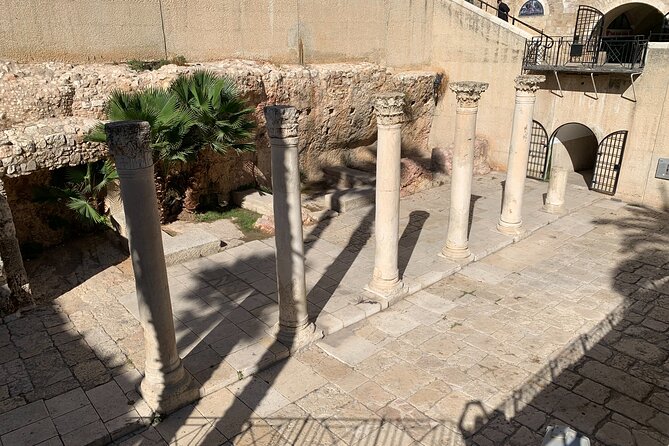
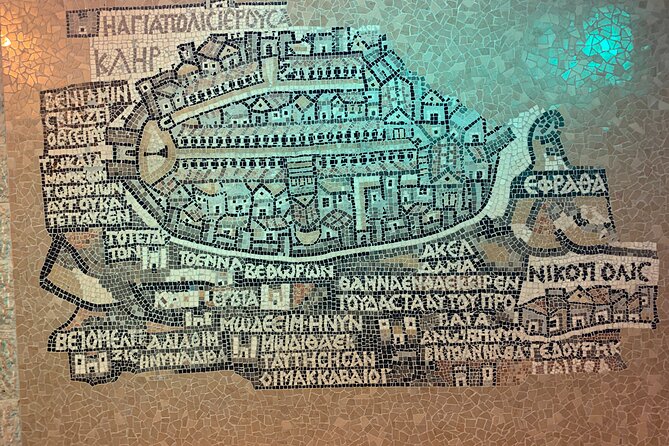
The Roman Cardo shifts the focus from biblical Jerusalem to the city rebuilt under Emperor Hadrian in the first half of the second century. Here, you walk on Roman pavement and see a replica of the Medeba Map, described as the oldest known map of Jerusalem.
This is one of the route’s most useful historical transitions. Jerusalem was not frozen in the period associated with the Bible or the life of Jesus. It was rebuilt, altered, and renamed across later eras. The Cardo lets you see a physical trace of that Roman chapter.
The pavement is especially valuable because it gives you something concrete to read while listening. Instead of receiving only dates and names, you can look at the remains beneath your feet and connect the explanation to the street itself.
The map replica adds another layer. A map can clarify a city in a way that a wall or ruin cannot. It helps you compare older ideas of Jerusalem with the streets you are walking today.
The supplied route information does not give a separate time estimate for this stop, so your pace will depend on how long you spend with the paving and map. That flexibility fits the format well.
Hezekiah’s-Era Remains Add a Biblical Time Depth
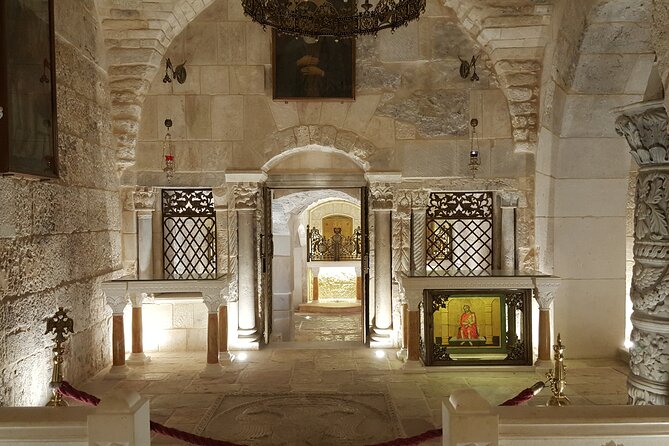
Another station focuses on a relic linked to Jerusalem in the Bible and dating to the time of King Hezekiah, about 2,700 years ago. The brief description does not name the relic, so you should rely on the app for the exact explanation when you reach it.
This stop matters because it pushes the timeline far earlier than the Roman Cardo and the later religious buildings. In a single walk, you move between ancient infrastructure, Roman urban planning, royal-era Jerusalem, and sacred traditions.
It is also a reminder that the Old City is not one historical period. You may be looking at a street used by modern residents while standing above remains from several earlier cities. The app’s value here is its ability to tell you what you are seeing and why it belongs in the story.
The Herodian Quarter Shows Jerusalem Before Destruction

The Herodian Quarter, also called the Wohl Archaeological Museum, focuses on first-century Jerusalem. The suggested time is about 30 minutes, and admission is not included.
The excavations reveal large homes and costly decorations, along with evidence of the city’s destruction by the Romans in AD 70. This is a powerful stop because it moves beyond grand religious landmarks and shows how wealthy residents lived before the city was devastated.
I find archaeological houses useful for understanding a city at human scale. Walls, rooms, and decorative details can explain social divisions and daily life more clearly than a broad historical speech. The evidence of destruction then gives the site a sharp ending, linking personal homes to one of Jerusalem’s great catastrophes.
Again, the extra admission charge is worth considering before you arrive. The $7 tour price covers the DGuide experience, not the museum entries. If you want the lowest-cost version, you can follow the route without entering. If you want the fullest archaeological picture, budget for admission and time.
The Western Wall Is a Major Emotional Pause

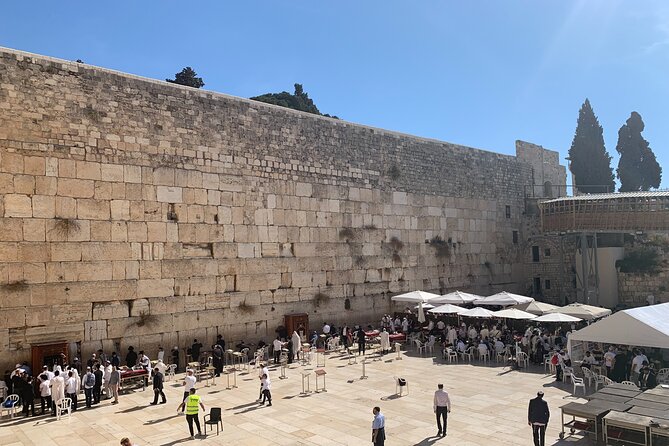
The Western Wall is allotted about 20 minutes and admission is free. It is described as a remnant of the Temple in Jerusalem and the closest place to the Temple Mount where Jews can pray.
This stop is not just another point on a sightseeing route. Its importance comes from its religious role and from the way people use the space. The app can provide context, but the atmosphere at the wall is something you need to observe quietly for yourself.
The 20-minute estimate gives you time to arrive, listen, and take in the setting, but it may feel brief if you want to sit, pray, or watch the flow of worship. Be respectful of religious practices and follow any posted instructions while you are there.
The Western Wall also marks a change in the rhythm of the walk. After museums and archaeological remains, you reach a living place of prayer. That shift is one of the tour’s strengths.
The Church of the Holy Sepulchre Ends With Jerusalem’s Most Important Christian Site
The final listed stop is the Church of the Holy Sepulchre, with about 30 minutes suggested. The church was first built in the fourth century and has gone through later reconstructions. It occupies the traditional location of the crucifixion and resurrection of Jesus Christ.
For Christian visitors, this may be the most important stop of the entire route. For others, it remains a major historical and architectural site, shaped by centuries of worship, rebuilding, and competing traditions.
The app’s historical approach is useful here because the church is not a single-period monument. Its present form reflects repeated changes. The tour can help you separate the original fourth-century foundation from later work and understand why the site has such lasting importance.
Thirty minutes may be enough for an introduction, but it is not a guarantee of a calm or complete visit. The church is a serious destination, and you may want more time than the suggested schedule allows. Since the tour is self-guided, you can make that choice without holding up a group.
The activity is described as ending back at the meeting point, which is listed at Jaffa Gate. Keep that in mind when planning the rest of your day, and allow time to return if you wander from the suggested route.
What the $7 Price Really Buys You
At $7 per person, this is a low-cost way to add structure to an Old City visit. The price is especially fair if you want historical background but do not need a live guide for every step.
You are paying for access to an organized route and the app’s commentary, not for museum entry, parking, or personal guiding. The Tower of David Museum and Wohl Archaeological Museum both charge separately, so your final cost depends on which interiors you choose to visit.
The strongest value comes from flexibility. A private activity with only your group can move at your speed, and you can decide where to spend your time. At the same time, the absence of a live guide means you should be comfortable using your phone and managing your own route.
Uri Goldflam’s reputation is another reason the content may appeal to history-minded visitors. The praise connected with his work repeatedly focuses on his broad command of Jewish and Christian heritage, his ability to explain the region, his humor, and his personal warmth. You are not getting a live version of Uri on the street, but the tour was designed around his experience as a guide and educator.
Who Will Get the Most From This Tour
I would recommend this experience to independent visitors who want more than a map but less than a full private tour. It suits couples, families with older children, and small groups who may not all want to stop for the same amount of time.
It is also a good fit for visitors with a strong interest in Jewish, Christian, Roman, and biblical history. The route gives you a broad introduction rather than concentrating on one faith or one era.
You should think twice if you want lively conversation, spontaneous questions, or help navigating every turn. The route requires walking and stairs, and a moderate level of fitness is advised. Public transportation is nearby, but parking fees are not included.
The listed operating hours are Monday through Thursday from 8:00 AM to 5:00 PM for the stated operating period. Check the timing before you set out, especially if you hope to visit both museums and still finish comfortably.
Should You Book It?
Book this tour if you want a flexible, inexpensive framework for seeing Jerusalem’s Old City and you are happy to guide yourself with your phone. The route covers an impressive range of places, and the historical sequence gives meaning to sites that can otherwise blur together.
Skip it if your priority is personal attention from a live expert. You will not have someone beside you to answer questions or adapt the commentary. For everyone else, $7 is a modest price for a thoughtful route through Jaffa Gate, Mount Zion, the Roman Cardo, the Western Wall, and the Church of the Holy Sepulchre.
Free cancellation is available if you cancel at least 24 hours before the scheduled start time. Cancellations made later are not refunded, and changes within that period are not accepted.
FAQ
How much does the Classic Jerusalem Old City Tour cost?
The tour costs $7 per person.
How long does the tour take?
The expected duration is approximately two to four hours.
Where does the tour begin?
The tour begins at Jaffa Gate in Jerusalem’s Old City.
Where does the activity end?
The activity is listed as ending back at the meeting point.
Are museum admission fees included?
No. Admission to the Tower of David Museum and the Wohl Archaeological Museum is not included.
Is the DGuide app included?
The DGuide app is free. After booking, you receive a coupon code in the Before You Go section of the confirmation email to access the tour.
Does the tour require much walking?
Yes. The experience requires walking and using stairs, and a moderate level of physical fitness is recommended.
More Self-Guided Tours in Jerusalem
- In The Footsteps of Jesus Day Tour – Dguide Self Guiding App
★ 4.5 · 3 reviews - From Tel Aviv: Dead Sea Self-Guided Chill-Out Day Trip
★ 4.2 · 64 reviews
Just added around Jerusalem
- jerusalem classic tour★ 5.0 · 3 reviews
- Jerusalem and the Dead Sea★ 5.0 · 3 reviews
- Private Walking Tour in Jerusalem’s Old City★ 5.0 · 3 reviews
- Jerusalem of 3 Religions in Russian★ 4.4 · 3 reviews
- Jerusalem Running Tour-Experience the unique vibes of Jerusalem in your sneakers★ 5.0 · 3 reviews
- From Jerusalem: Masada Sunrise, Ein Gedi & Dead Sea★ 5.0 · 3 reviews
- Christian Jerusalem in Russian★ 5.0 · 3 reviews
- Hebron & Ramallah Full-Day Guided Tour from Jerusalem★ 5.0 · 3 reviews
Jerusalem Old City Tours, compared.




Jerusalem Half Day Tour: Holy Sepulchre and Western Wall
Read our review →
Jerusalem Half-Day Tour from Tel Aviv: Holy Sepulchre and Western Wall
Read our review →

City of David and Underground Jerusalem Day Tour
Read our review →Browse the lists this tour appears in